A positive HPV (human papillomavirus) result is not a diagnosis that leads straight to cervical cancer. The conclusion is that, depending on whether the type is high-risk and whether the infection persists without clearing for 2 years or more, cases divide into those that need treatment and those where observation alone is enough.
This article covers, in order, the stages by which HPV infection progresses to cell changes, the criteria that mark when treatment is needed, and the principle and clinical results of photodynamic laser therapy (PDT), which helps clear the virus while preserving cervical tissue.
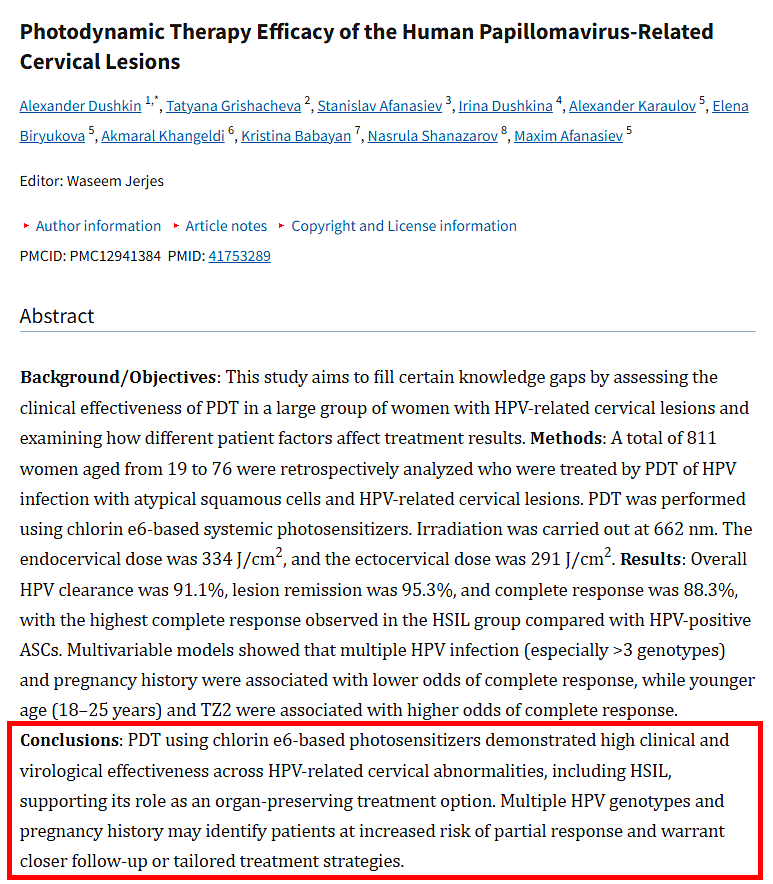
A retrospective analysis of 811 people showed an HPV clearance rate of 91.1% and a complete remission rate of 95.3%.
Does a positive HPV result always need treatment?
HPV infection does not turn into cancer straight away. Cell changes progress in order from mild (CIN1) to moderate (CIN2) to severe (CIN3), and the response and the interval for testing and observation differ with the stage.
When cervical cytology is abnormal, HPV testing checks the type, such as 16 or 18, and the likelihood of persistent infection or natural recovery, and the suspicious area is then examined with a colposcope.
- Repeated detection of high-risk HPV types 16 and 18 — cases where type testing has repeatedly detected high-risk virus
- Infection lasting 2 years or more — infection that does not clear on repeat tests and continues for more than 2 years
- Recurrent condyloma — cases where condyloma, in the form of genital warts, reappears even after treatment
If treatment is needed, does it have to be surgery?
In PDT photodynamic laser therapy, a gel photosensitiser is applied to the cervix and a laser is then directed at it, so that only infected cells react and the virus is removed by reactive oxygen, with no effect on normal tissue.
A related clinical paper reports that a retrospective analysis of 811 people showed an HPV clearance rate of 91.1% and a complete remission rate of 95.3%. Unlike conization, it preserved cervical tissue while clearing the virus at a high rate.
Does it also help with vulvar itching or dryness?
When photo-laser treatment was given to 30 patients with vulvar itching, burning pain and tissue atrophy, the itching disappeared completely in 27 cases and the other 3 cases also improved to a mild level.
Most participants answered that they were satisfied or very satisfied, which supports the view that PDT laser removes inflammatory cells in the vulvar mucosa and helps epithelial regeneration and the improvement of itching and dryness.
What should guide the choice of a clinic for treatment?
Even when treatment works well, the type of photosensitiser, the wavelength and the number of treatments differ with age, cell changes and the extent of the lesion, and the recovery response can also differ with immune status.
If recovery is slow or immunity within the uterus is reduced, HPV can remain after treatment and further treatment may be needed, so a clinic that explains the treatment plan and designs the direction of care through ongoing monitoring is a good choice.
- Checking the current condition — a consultation that identifies the stage of cell change and the duration of infection in concrete terms should come first
- Explaining why treatment is needed — you should receive a concrete explanation of the grounds for having treatment now
- A plan for care after treatment — you should confirm how progress will be observed and managed after treatment